THE MARITIME ATLASThe Bluenose

A SCHOONER'S RECORD · 1921—1946 · BLUENOSE II SINCE 1963

The Bluenose

A hundred and forty-three feet (43.6 m) of Lunenburg oak.
Seventeen years with the trophy. A dime in every pocket.

01 · SAIL PLAN · DRAWN FROM HER REGISTERED DIMENSIONSBOW TO THE RIGHT

Sail plan of the Bluenose

Hull 143 ft (43.6 m), waterline 112 ft (34.1 m), mainmast 125 ft 10 in (38.4 m) above deck, main boom 81 ft (24.7 m): the figures the Nova Scotia Archives hold from her 1921 registration. Gaffs, topmasts and the foremast are set to the 1921 photographs. How she was drawn ↗

↑ BACK TO TOP

RACE CLOCK9:00:00
—at the start line
Leg 1 of 5a reach of six miles (11 km) to the inner automatic buoy
45-second race

↑ BACK TO TOP

02 · HALIFAX APPROACHES · OCTOBER 1921INTERNATIONAL FISHERMEN'S RACE · BLUENOSE v ELSIE
Charting the approaches…
Forty miles (about 72 km) on the newspaper's clock.
Hover a schooner or a mark. Marks are placed from the printed legs.
Bluenose Elsie, of Gloucester Mark, placed from the printed leg lengths Start and finish line Course marks are not chart positions. Times, legs and wind are as printed.
Race

Course Number 3: five legs, 39 miles (about 72 km). Wind north-west, 25 to 27 knots (46 to 50 km/h). Elsie lost her foretopmast.

03BUILT TO FISH, BUILT TO RACE

A working schooner
with a trophy to win back.
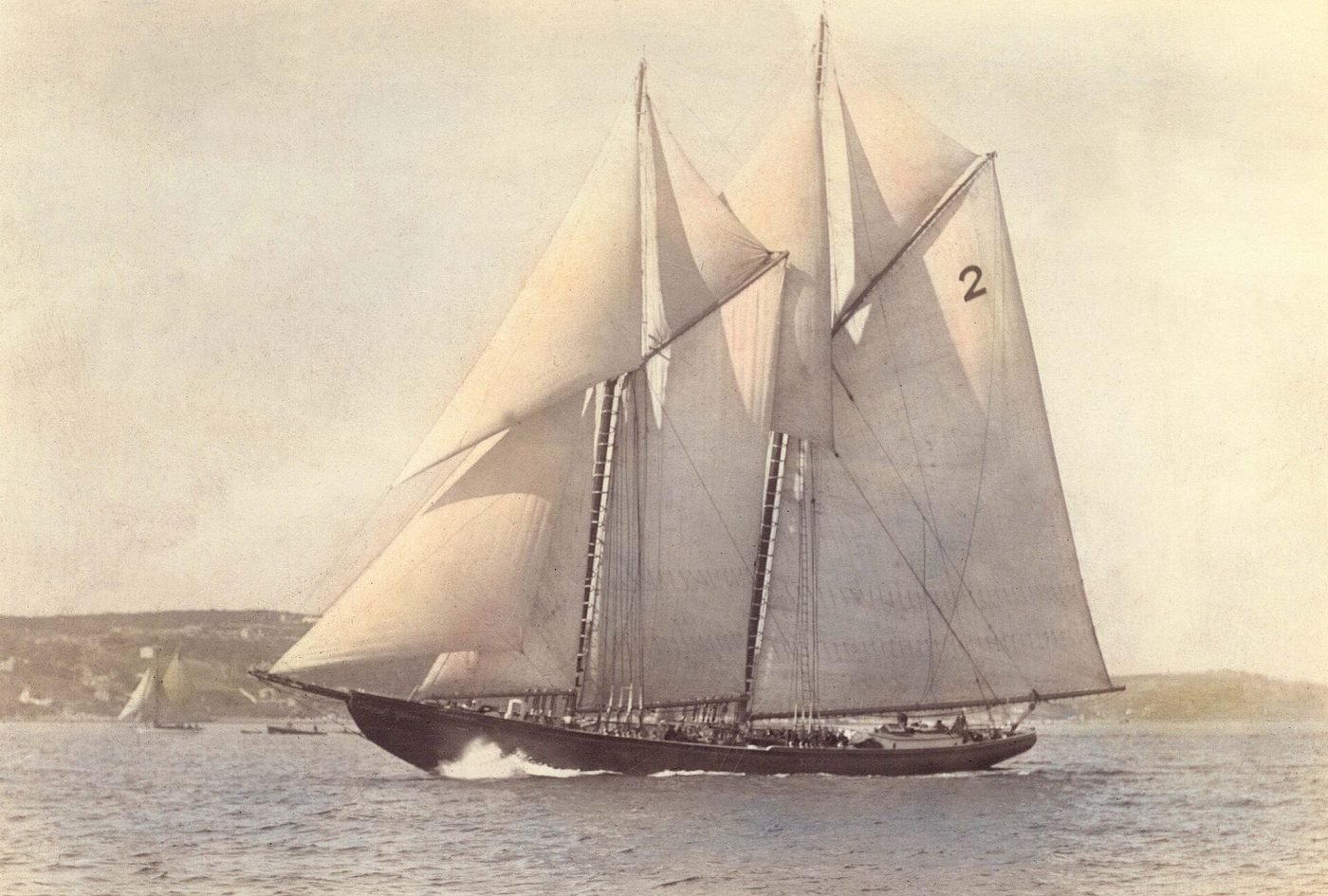
The Bluenose under full sail off Halifax in October 1921, a two-masted schooner with a large racing number 2 on her mainsail, heeling slightly, with a low shore behind her.
October 1921, the Nova Scotia elimination trials off Halifax. W. R. MacAskill, hand-coloured by Elva MacAskill. Nova Scotia Archives, Wallace MacAskill Collection, ref. 20040026. Public domain, via Wikimedia Commons.

In 1920 the Halifax Herald put up a trophy for the fastest fishing schooner on the North Atlantic, and a Gloucester boat took it home in the first series. Nova Scotia answered with a new vessel. William J. Roué, a self-taught Halifax designer who had drawn yachts, drew his first working fishing schooner: design number 17. Four Halifax businessmen and a Lunenburg captain named Angus Walters paid the $35,000.

Smith & Rhuland laid her keel in December 1920. She was launched on 26 March 1921, christened by Audrey Smith, the builder's daughter, and three weeks later she left for the Grand Banks. She was a saltbanker first: eight dories, two men to each, lines of hooks two and a half kilometres long, a hold to fill before she could race. Speed paid twice over. The first schooner home sold her catch at the best price.
↑ BACK TO TOP

04THE SKIPPER

Angus Walters.

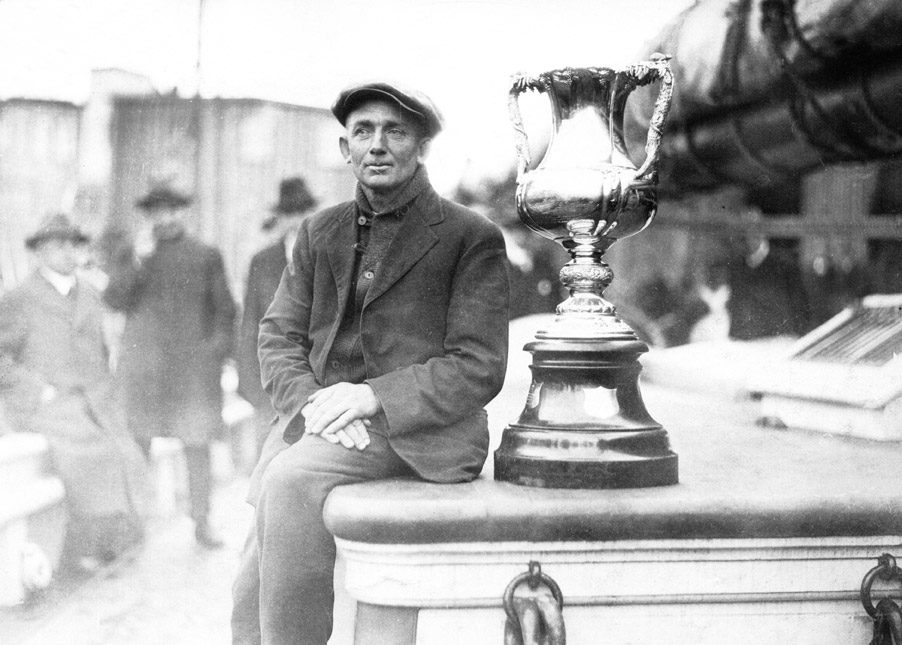
Born in Lunenburg in 1881 (one source says 1882), at sea from the age of fourteen as a deckhand for his father, Walters was chosen to skipper the Bluenose while she was still on the stocks. He bought a controlling share and insisted on changes to the design, among them a higher bow for a drier forward deck. He could find fish and he could make a vessel go. He sailed her for seventeen years of racing and never let the trophy leave Nova Scotia.

In November 1939, an hour before she was to be auctioned, he paid $7,000 to keep her. He sold her in 1942 and, the story goes, wept on the Lunenburg waterfront as she left. He died in Lunenburg on 11 August 1968, five years after sailing on the maiden voyage of Bluenose II.

Captain Angus Walters seated on the deck of the Bluenose beside the tall silver International Fishermen's Trophy, 1921.
Captain Angus Walters with the International Fishermen's Trophy on the deck of the Bluenose, 1921. W. R. MacAskill. Nova Scotia Archives. Public domain, via Wikimedia Commons.

↑ BACK TO TOP

05THE RACES

Six series.
The trophy never left.

The International Fishermen's Trophy, and the one cup she lost
YearAgainstWhereResult
1921Elsie, Gloucesteroff HalifaxBluenose, two races to none
1922Henry Ford, Gloucesteroff GloucesterBluenose, three to none
1923Columbia, Gloucesteroff HalifaxFirst home twice; the second race awarded to Columbia over a buoy; no third race sailed. The records disagree on how it was scored.
1930Gertrude L. Thebaud, Gloucesteroff GloucesterLipton Cup, not the Trophy: Thebaud won
1931Gertrude L. Thebaudoff HalifaxBluenose
1938Gertrude L. Thebaudoff Boston and GloucesterBluenose, three races to two. The last series ever sailed.
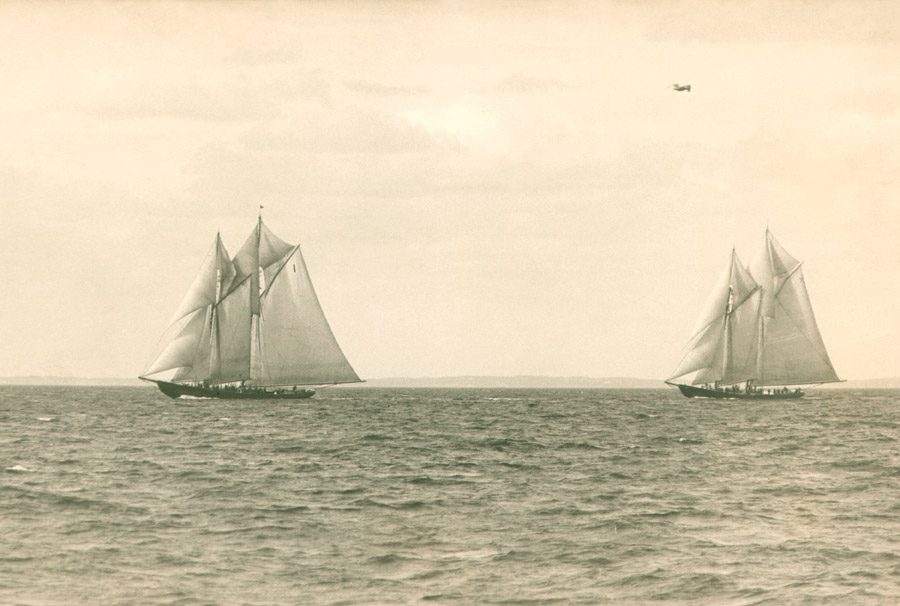
Two gaff-rigged fishing schooners racing close together off Gloucester in 1922, a seaplane overhead.
Bluenose and Henry Ford, off Gloucester, October 1922. W. R. MacAskill. Nova Scotia Archives. Public domain, via Wikimedia Commons.

"Undefeated" is true of the Trophy. She lost single races, lost the 1930 Lipton Cup series to Thebaud, and in 1923 sailed home without a clean result. No challenger ever took the International Fishermen's Trophy from her. The 1938 series, off Boston and Gloucester against Thebaud, was the last ever sailed between North Atlantic fishing schooners, and the deciding race on 26 October was won by two minutes fifty seconds. That is the race the Heritage Minute shows.

↑ BACK TO TOP

06THE DIME

1937.
A schooner in every pocket.

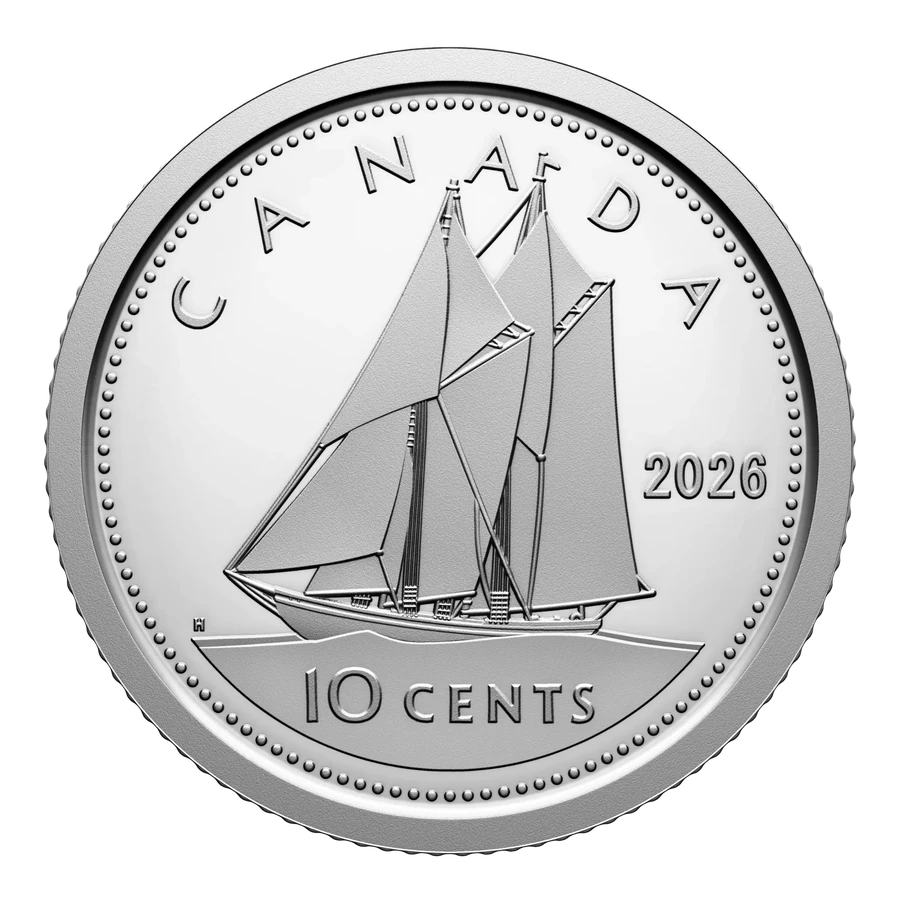
In 1937 the Royal Canadian Mint issued new designs for Canada's coins. The ten-cent piece carried a sculptor's profile of a fishing schooner under full sail, by Emanuel Hahn of Toronto. The Mint says he worked from photographs of the Bluenose. Hahn himself wrote only "schooner" on his drawing, and for sixty-five years the coin was officially unnamed, though no one in Nova Scotia had any doubt.

On 15 March 2002, after a campaign led by Senator Wilfred Moore, the Mint confirmed it: the schooner on the dime is the Bluenose. She has been there, with one year's exception, ever since. For the hundredth anniversary of her launch in 2021 the Mint struck coloured dimes dated 1921–2021.

The coin shown is the Royal Canadian Mint's own photograph of the 2026 ten-cent piece. The design and the photograph are the Mint's. You have the real thing in your pocket.

The reverse of the 2026 Canadian ten-cent coin: CANADA around the top, the Bluenose under full sail heading right, 10 CENTS on a band of sea, the year at the right, a ring of beads inside a raised rim.
The 2026 ten-cent piece, reverse. Emanuel Hahn's design, 1937. Photograph: Royal Canadian Mint.
1937Hahn's schooner is first struck
1967Alex Colville's mackerel for the Centennial
1968The schooner returns
2001International Year of Volunteers design
200215 March: the Mint names her
2021Coloured centenary dimes, 1921–2021

↑ BACK TO TOP

07THE END

A reef off Haiti,
28 January 1946.

Engines came in 1936 and the topmasts came down. The salt fishery that built her was ending; diesel trawlers and cold storage were taking its place on the Lunenburg waterfront. In 1942 she was sold to the West Indies Trading Company, stripped of her racing rig, and put to carrying freight between the islands.

On 28 January 1946, laden with bananas, she struck a coral reef off Île-à-Vache, Haiti, and was lost. No one died. Her rivals had gone before her: Esperanto and Columbia to Sable Island, Henry Ford to Newfoundland, Elsie off St-Pierre. Thebaud followed in 1948, off Venezuela.

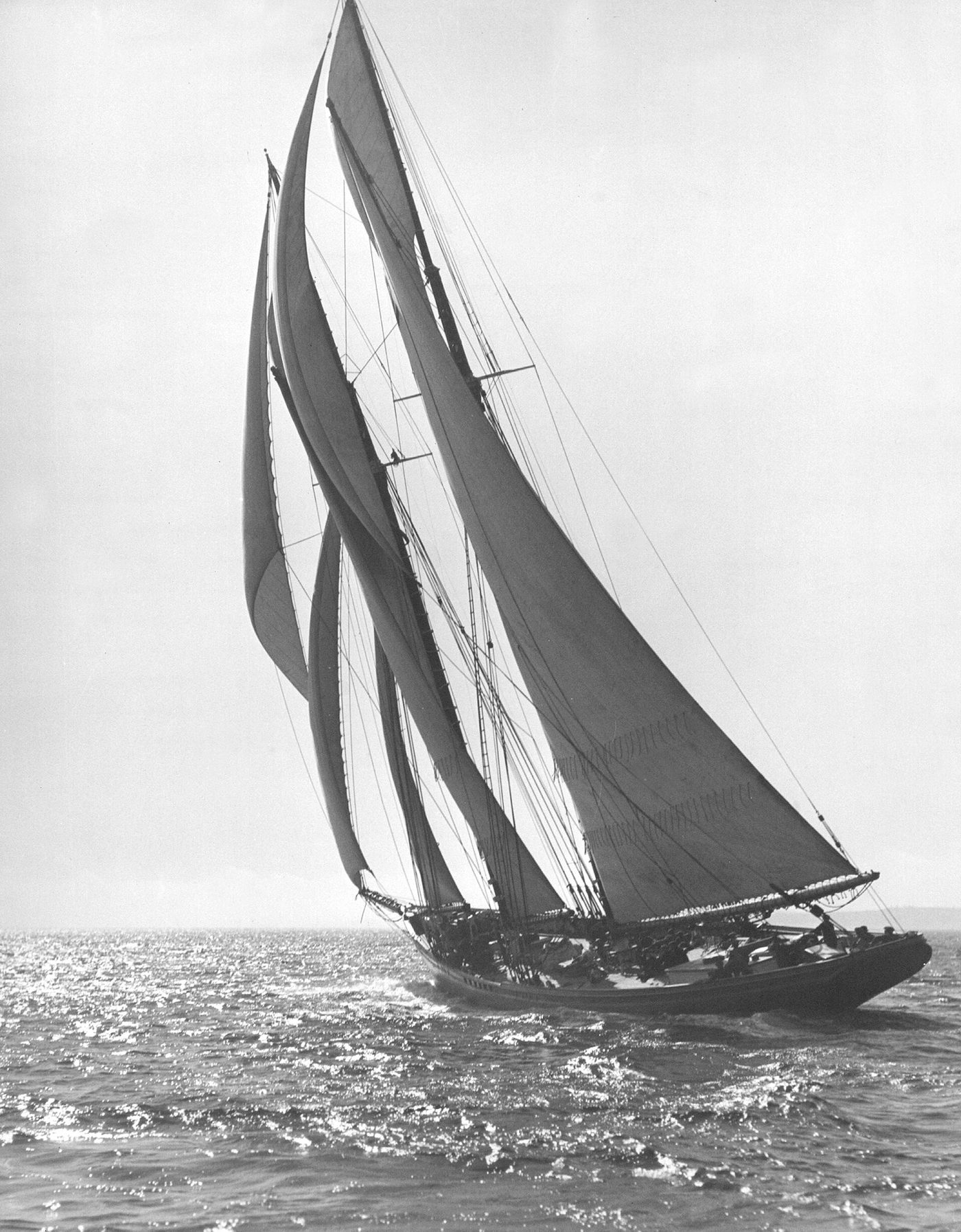
The Bluenose heeled hard under full sail, crew on deck, photographed from astern as she sails away, 1921.
Bluenose sails away, 1921. W. R. MacAskill. Nova Scotia Archives, Wallace MacAskill Collection, ref. 20040025. Public domain, via Wikimedia Commons.

↑ BACK TO TOP

08BLUENOSE II

Built again,
given away for a dollar.

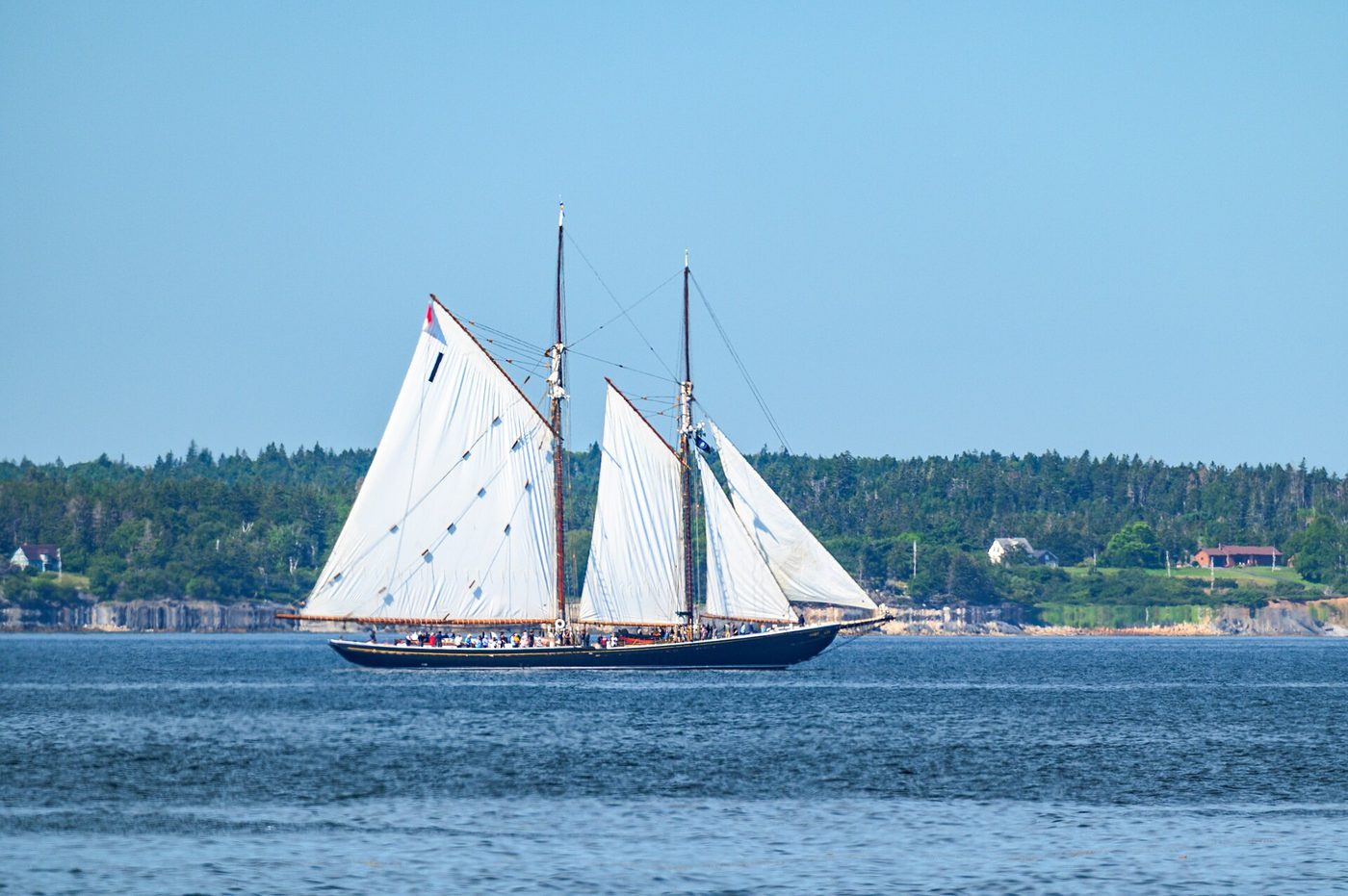
Bluenose II under sail off Blue Rocks near Lunenburg in 2022, black hull, white sails, a small crowd of people on deck.
Bluenose II off Blue Rocks, Lunenburg Bay, 4 August 2022. Gordon Leggett, CC BY 4.0, via Wikimedia Commons.

Seventeen years after the wreck, the same yard built her again. Smith & Rhuland laid down Bluenose II from Roué's plans for the Oland brewery, which wanted a floating advertisement for its Schooner beer and got a national one. She was launched on 24 July 1963 before a crowd of about 50,000. Angus Walters, eighty-two, sailed on her first voyage.

In 1971 the Olands gave her to the Province of Nova Scotia for one dollar. She has been the province's sailing ambassador since, out of Lunenburg. A rebuild announced in 2009 at $14.4 million relaunched a new hull in 2012, returned her to full service in 2015, and closed its books in 2017 at $24.3 million, with the Auditor General's report alongside. She does not race. She sails every summer from Lunenburg.

Two ships, one set of plans
FigureBluenose, 1921Bluenose II, 1963
Hull143 ft (43.6 m)46 m (151 ft)
Waterline112 ft (34.1 m)34 m (112 ft)
Beam27 ft (8.2 m)8 m (26 ft)
Draught15 ft 10 in (4.8 m)5 m (16 ft)
Sail10,000 sq ft (930 m²)1,036 m² (11,150 sq ft)
Masts above deck125 ft 10 in (38.4 m); the foremast as photographed38 m and 36 m (125 ft and 118 ft)
PowerSail; diesels fitted in 1936Two 250 hp diesels
Crew20, with 8 dories5 officers, a cook, 12 deckhands
Built forThe Banks, and the TrophyThe Oland brewery; the province from 1971
Cost$35,000About $300,000; sold for $1
WHERE SHE SAILS · 2026 SEASONPUBLISHED SCHEDULE · LIGHTS ARE TOWNS, NOT BERTHS

Lunenburg is home. The 2026 schedule: Halifax 17–21 June for SailGP and 12–13 September for the Maritime Heritage Festival; Sail Boston 11–16 July; Chester Race Week 11–12 August; Arichat 16 August; Sheet Harbour 19 August; Shelburne 30 August; Clark's Harbour 2 September. Weather moves the plan; the published schedule is what is drawn.

↑ BACK TO TOP

THE YEAR1920
0of 27 dated moments

09A LIFE

A life, 1920 to 2026

Launch, races, the dime, the loss, and the ship that carries her name.
30-second life

    ↑ BACK TO TOP

    10THE HERITAGE MINUTE

    Sixty seconds, 1938.

    Historica Canada's Heritage Minute on the Bluenose, released in 1995, puts Wayne Robson at the wheel as Angus Walters in the last and closest series of her career: 1938, against the American schooner, off Boston and Gloucester. Its closing line about seventeen years unbeaten is the trophy's record, not the record of every race, and the table above has the difference.

    The film is Historica Canada's. It plays here in their own YouTube player and is not stored on this site. Pressing play loads YouTube.

    The 1938 series, as the papers printed it
    DateWhereResult
    9 Octoff Nahant, BostonThebaud by 3 min 4 s, on a 36-mile (67 km) course sailed twice round an 18-mile (33 km) triangle
    13 Octoff GloucesterBluenose by 11 min 58 s: first mark 2.08 to 2.20.23, second 2.56.08 to 3.09.09, finish 4.29.10 to 4.41.08
    23 Octoff GloucesterBluenose by 6 min 39 s, after two starts abandoned for want of wind and a dispute over her ballast
    24 Octoff Nahant, BostonThebaud by about 5 min over a 35½-mile (66 km) triangle
    26 Octoff BostonBluenose 4.04.10, Thebaud 4.07. Two minutes fifty seconds, and the trophy stays in Lunenburg

    ↑ BACK TO TOP

    11READING THIS PAGE

    Drawn from the record.
    Nothing invented.

    The sail plan is built from the dimensions in her 1921 registration, held by the Nova Scotia Archives. Where the record is silent, the gaffs, topmasts, bowsprit and the foremast's height follow the 1921 photographs of W. R. MacAskill. The registry's foremast figure, 102 ft 6 in (31.2 m), does not match any photograph and is noted, not drawn.

    The race is the first International Fishermen's Trophy series she sailed, 22 and 24 October 1921 off Halifax, as the Canadian Press reported it from the committee steamer Tyrian: the legs, the marks by name, the wind, and the official times at the start, at the marks and at the finish. The buoys had no recorded position. Each is placed from the printed leg lengths and the land feature it was named for, and drawn with a dashed halo to say so.

    Between two timed points a schooner moves at an even pace along the course. The shoreline is Statistics Canada's 2021 cartographic boundary, clipped to this frame at about ten metres' (33 ft) tolerance. It is a modern shore and an illustrative map, not a chart.

    The Heritage Minute shows the 1938 series, the last ever sailed. The 1938 wire reports give course lengths and finishing times but name no buoy or start line, so there is nothing to place on a map; the series is given as a table instead.

    Read the data method ↗

    ↑ BACK TO TOP